Boxing Star:Sports Action Game
- 4.6
- Rating
- 10.00M
- Installs
- Free
- Price

 Analysis by App-foxy
Boxing Star:Sports Action Game caught my attention because it presents boxing as something bright, dramatic, and immediately playable rather than as a slow simulation. After spending time with it, I found a mobile sports game that understands the value of a quick punch, a clear visual reaction, and a match that gets moving without a long explanation. It is free to play, belongs to the sports category, and comes from ThumbAge Co., Ltd. Its colorful presentation makes it approachable, but the later fights ask for more attention than the first rounds suggest.
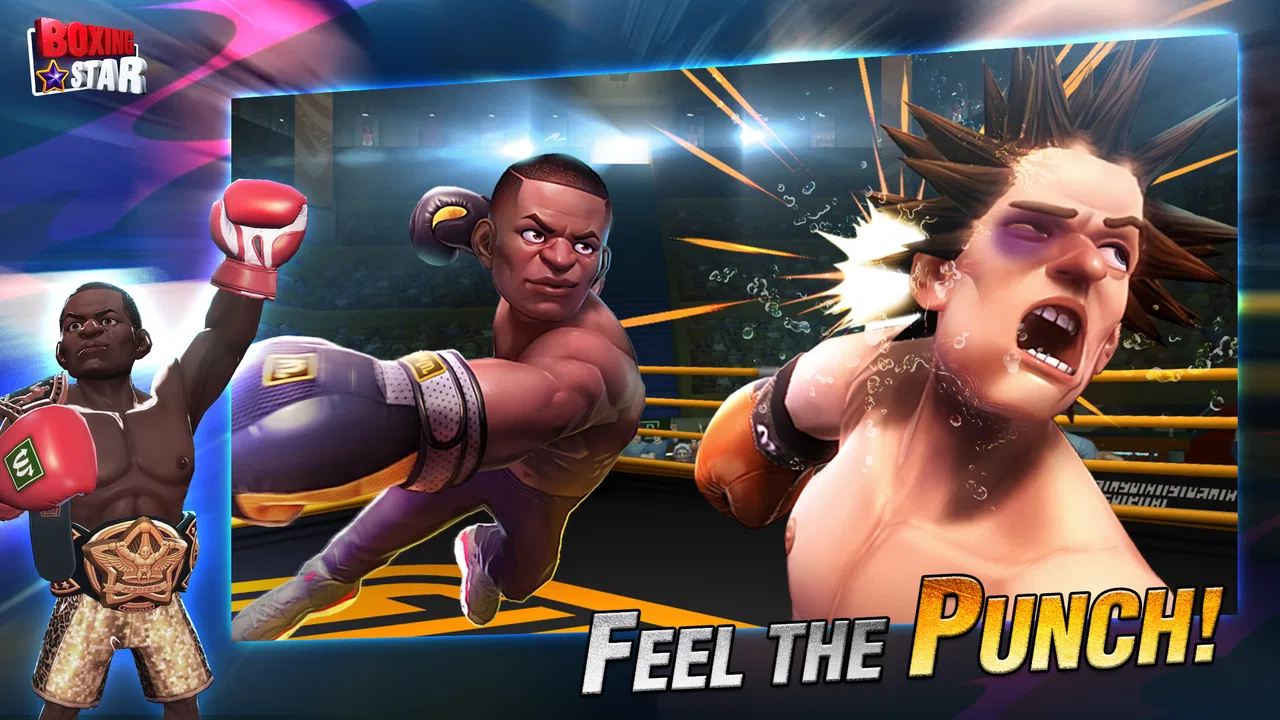
My first impression was shaped by its exaggerated comic-book attitude. The fighters look larger than life, the action is easy to read on a phone screen, and every exchange aims to feel like an event. That style is important because a boxing game can become visually repetitive when every bout uses the same ring and the same basic motions. Here, the presentation gives the punches personality and helps the game feel closer to an interactive sports cartoon than a dry technical simulator.
The game is rated Teen, so I would not treat it as a child-focused title despite its colorful appearance. It is better suited to players who enjoy energetic competition, gradual improvement, and a little theatricality around their matches. I also appreciate that the entry cost is low: you can begin without paying, while optional purchases range from $0.99 to $99.99 per item. That makes trying it easy, although the presence of broad purchase tiers is worth remembering if you prefer games with a completely predictable spending path.
You May Also Like

 Google Keep - Notes and lists
Google Keep’s Quiet Growth Shows the Appeal of Simpler Notes
As mobile work gets busier, Google Keep keeps winning a simple contest: capture a thought quickly, find it later, and get on with the day.

 Blood Strike: 2.5 Anniversary
Blood Strike’s Loadouts Turn Every Drop Into a Tactical Gamble
A close look at Blood Strike’s custom loadouts: how fast access to signature weapons reshapes its battle royale rhythm, rewards preparation, and narrows the gap between fights.

 Pandora - Music & Podcasts
Pandora’s Music Is Easy to Start, but Harder to Recover
Pandora’s strength is its low-effort path from a seed to a station. Its weak spot is how much confidence it asks you to place in connection, setup, and quiet recovery.

 8 Ball Pool
 Is Built on Rivalries, Rematches, and Routine
A close look at the rivalries, rematches, shared routines, and unanswered safety questions that turn a quick pool match into a persistent mobile community.

 Samsung Music
’s Quiet Strength Is Playing What You Already Own
Its reach comes less from spectacle than from dependable access to a personal library. That simplicity is both the app’s strongest retention engine and its ceiling.

 AccuWeather: Weather Radar
AccuWeather Review: A Quick, Clear Forecast for Everyday Decisions
For everyday plans, the best forecast is the one you can understand quickly. AccuWeather makes rain timing, radar, and local conditions easy to act on, with a few trade-offs.
More From Our News Desk



Why the presentation works before the deeper systems appear
I find that Boxing Star’s presentation does a useful job before its progression and match decisions have time to become demanding: the expressive visuals make the action easy to follow, while the lively atmosphere gives a brief bout a sense of occasion. That accessibility is a good entry point, but it also sets expectations; next, I’d look at how the game’s deeper systems turn those quick matches into a longer routine.
A comic-book ring with a clear visual language
The art direction does more than decorate the boxing. It tells me how to read the action. Strong poses, emphatic reactions, and a deliberately heightened sense of impact make the important moments stand out. I rarely feel lost about what the game wants me to notice: the opponent’s movement, the opening for an attack, or the result of a well-timed exchange. That clarity matters on a touchscreen, where a busy interface can make a sports game feel uncomfortable very quickly.
Instead of aiming for realistic broadcast presentation, the game builds a stylized boxing world. That choice gives it a distinctive mood and lets it move quickly between training, preparation, and competition without requiring the seriousness of a full console boxing simulation. The setting feels like a stage for rivalries and personal progress. Even when the underlying action is straightforward, the visual framing encourages me to treat each opponent as a character rather than merely another health bar.
One practical benefit of this style is that it makes short sessions feel complete. I can open the game, understand the immediate objective, and enjoy a compact burst of action without needing to reconstruct a complicated ruleset. The trade-off is that players seeking authentic ring strategy, realistic body movement, or a broadcast-style atmosphere may find the tone too exaggerated. This is a game about the drama of boxing, not a substitute for a detailed professional simulator.
The strongest visual choice is the way the game turns impact into readable feedback. A punch feels important because the animation, pose, and timing work together. That does not automatically make every encounter deep, but it gives the basic interaction a satisfying shape. I found myself paying attention not only to winning, but also to whether an exchange looked and felt clean.
Progression feels more personal when preparation has a purpose
What keeps the experience from being just a sequence of disconnected bouts is the sense that my boxer is moving through a career-like journey. The appeal is not limited to tapping through one opponent after another. I am also thinking about how to approach the next challenge, when to improve, and whether a short session should be used for action or preparation. That loop gives the game a useful rhythm: fight, assess, adjust, and return.
A tip that helped me was to avoid treating every match as a test of reflexes alone. When a fight starts feeling difficult, I look at the problem as a preparation issue first. Am I entering with an approach that suits the opponent? Am I rushing because the early exchanges feel easy? Am I spending resources simply because I want the next fight immediately? This mindset makes the progression less frustrating and helps separate a genuine tactical mistake from a boxer who simply needs more development.
That is also where the free-to-play structure becomes relevant. Optional purchases can reduce waiting or make progress feel more comfortable, but I would not advise spending impulsively after one difficult match. The better habit is to identify what is actually slowing you down. If the problem is poor timing, a purchase will not teach better timing. If the issue is that you enjoy the game enough to support it, that is a more sensible reason to spend than chasing a single victory.
Sound gives the punches a sense of timing
The audio presentation supports the same energetic mood as the art. Boxing depends heavily on rhythm, and sound helps divide a match into recognizable moments: approach, exchange, impact, recovery, and renewed pressure. Even when I am not consciously analyzing the audio, it makes the action feel less flat. A punch without a convincing response can feel like a menu tap; a punch supported by the right sound becomes part of the match’s dramatic beat.
I especially like how the sound design works with the game’s exaggerated visual language rather than fighting against it. The presentation does not ask me to imagine a quiet training hall or a realistic television broadcast. It wants the ring to feel lively and heightened. That choice keeps the atmosphere coherent, although players who prefer subdued sports audio may find the constant energy tiring during longer sessions.
For everyday use, I would play with the sound on when I want the full mood and lower it when I am using the game in a public place. The visual feedback remains important, but muting any action game removes some of its timing cues. If you are learning the pace, audio can help you notice when an exchange has ended and when it is safer to act again. I would not rely on sound alone, but it is more useful here than a purely decorative soundtrack.
Fast action works best when I stop chasing every opening
The central mechanical appeal is the relationship between offense and restraint. The game makes attacking feel inviting, especially when an opponent appears vulnerable, but constant pressure is not always the smartest response. I had better results when I treated openings as opportunities rather than commands. Waiting a moment can make the next attack more deliberate, while rushing can turn a promising exchange into a problem.
This is one of the more useful non-obvious lessons in the game: visual excitement can tempt you into poor decisions. The comic presentation makes every opening look dramatic, but not every opening deserves an immediate response. I found it helpful to watch the opponent’s pattern for a short stretch before committing heavily. That approach is particularly valuable for players who come from casual tapping games and expect the fastest possible input to be the best input.
The controls are designed for touch rather than for a complicated controller layout, which makes the game accessible on a range of phones. At the same time, touchscreen action always has limits. Fingers can cover part of the display, accidental inputs are possible, and a player’s comfort depends on the size and responsiveness of the device. I would choose a stable grip and avoid playing while walking or multitasking. The game rewards attention more than its bright style initially implies.
The pacing is one of its clearest strengths. Matches can deliver a satisfying burst of action without requiring the long commitment associated with a full sports career mode on a console. That makes it a good companion for a break, a commute with reliable connectivity, or a few minutes before bed. However, the same quick rhythm can become repetitive if you want every fight to introduce a radically different tactical puzzle. Its variety comes from progression, opponents, and the changing pressure of the journey rather than from transforming boxing into a completely different genre each round.
How it compares with other mobile sports choices
Compared with a realistic boxing simulator, this game is easier to approach and more focused on spectacle. You do not need to understand a detailed professional rulebook before enjoying the first match. The cost of that accessibility is reduced realism. A player who wants authentic footwork, careful judging, or a slow study of ring positioning may be happier with a simulation built around those priorities.
Compared with a general arcade sports game, it offers a more concentrated identity. There is no need to switch between unrelated sports or learn a large collection of modes before getting to the main attraction. The entire experience is built around the boxer’s rise, the feel of exchanges, and the visual drama of the ring. That focus is a strength for boxing fans, but it also means the game cannot hide behind variety if its particular combat rhythm stops appealing to you.
It also differs from a simple one-touch time killer. Although the presentation is immediately friendly, it asks me to think about preparation, pacing, and when to commit. That makes it more rewarding than a game where success depends only on speed. On the other hand, someone looking for a completely relaxed experience may find the increasing pressure less comfortable than a puzzle or idle sports title.
Who will enjoy it, and who should look elsewhere
I would recommend it to players who want a boxing game with a strong visual identity, quick matches, and a progression loop that gives repeated play a reason. It is particularly suitable if you enjoy sports games that sit between simulation and arcade action. The free starting point also makes it easy to test whether the tone and touch controls suit you before making any commitment.
I would be more cautious about recommending it to someone who dislikes in-app purchases on principle. Even if you can begin without paying, the purchase range means the game is built around optional spending as part of its wider structure. I would also point simulation fans toward a different option if realism is their main requirement. The colorful art, heightened impact, and brisk pacing are central to the identity here, not minor surface details that can be ignored.
Players who need a game that works as a completely silent background activity may also want to look elsewhere. The audio and visual reactions contribute to the timing and mood, so the experience loses some of its character when treated as something to play without attention. Likewise, if you want a single fixed campaign that ends neatly, the ongoing progression style may feel less satisfying than a premium game with a clearly defined finish.
Practical advice for getting more from each session
My first suggestion is to use early fights as observation time. Do not spend every exchange trying to prove that you can attack faster. Watch how the opponent behaves, notice when you are being drawn into a bad trade, and use that knowledge before increasing your pace. This makes later bouts feel less like walls and more like tests of whether you understood the lesson from the previous one.
Second, separate improvement from impatience. When progress slows, take a moment to decide whether you need a better approach or simply want to skip the uncomfortable part. That distinction protects both your enjoyment and your budget. In a free-to-play sports game, the most useful purchase decision is usually the one made after you understand why you are stuck, not the one made during frustration.
Third, match the session length to the game’s strengths. A short run of fights works well when I want immediate energy, while a longer session is better reserved for moments when I am willing to concentrate on patterns and progression. Playing carelessly for too long can make the repeated structure feel more obvious. Short, focused visits preserve the sense of occasion that the art and sound are trying to create.
Technical fit and long-term appeal
The current version is 7.5.1, and the game supports devices running Android 6.0 or later. That broad compatibility makes it a realistic choice for people who are not using a recent flagship phone. Still, compatibility does not guarantee identical comfort on every device. Screen size, touch response, battery condition, and available storage can all affect how pleasant an action game feels, so I would judge the experience on the phone you actually plan to use rather than assuming the same feel everywhere.
The game’s audience is substantial, with over ten million installs, and its average rating is 4.6 from around 860 thousand ratings. Those figures suggest that the basic combination of boxing action and stylized presentation has connected with a large mobile audience. I would read that as a useful sign of broad appeal, not as proof that every player will enjoy the monetization or the repeated progression. The most important question remains whether you like this particular balance of spectacle, timing, and development.
Its long-term appeal depends on how much satisfaction you get from refining a familiar loop. If you enjoy returning to improve a boxer, overcome a difficult rival, and make each exchange look cleaner, the structure can hold your attention. If you need constant mechanical reinvention, the core format may eventually feel narrow. The game is strongest when I accept it on its own terms instead of expecting it to become a realistic boxing simulator or a limitless action game.
My final take on the ring
After reviewing it as a sports game rather than judging it only by its store summary, I see a title with a clear personality. The art direction makes boxing feel theatrical, the sound reinforces the rhythm of each exchange, and the pacing suits mobile sessions without removing the need for attention. Those elements fit together well: the world looks energetic, the audio makes impact readable, and the mechanics give that energy somewhere to go.
There are real compromises. The stylized tone will not satisfy every simulation fan, touchscreen play cannot eliminate the limits of mobile controls, and the free-to-play purchase structure deserves a measured approach. Repetition may also become noticeable for players who want a constantly changing set of mechanics. I would not recommend it blindly to everyone who likes sports games.
For me, though, the balance is convincing. Boxing Star:Sports Action Game is at its best when I treat each short bout as a lesson in rhythm rather than a frantic race to attack. If you want accessible boxing with a bold comic-book mood, meaningful progression, and enough tactical pacing to reward patience, it is worth trying. If your priority is realism, silence, or a fully premium experience with no purchase pressure, another kind of boxing game will be a better fit.
FAQs for Boxing Star:Sports Action Game
01What are the main features of Boxing Star: Sports Action Game?
Boxing Star offers a thrilling boxing experience with stunning graphics and intuitive controls. The game features a Story Mode where players rise through the ranks, multiplayer battles, and customization options for characters. Players can also join Fight Clubs and participate in exclusive events, enhancing the competitive aspect.
02Is Boxing Star free to play, and are there in-app purchases?
Yes, Boxing Star is free to download and play on both Android and iOS platforms. However, it includes in-app purchases that allow players to buy in-game currency and items. These purchases can enhance gameplay but are not necessary to enjoy the full experience of the game.
03What devices are compatible with Boxing Star?
Boxing Star is available for both Android and iOS devices. It requires Android 4.4 or later and iOS 10.0 or later. The game is compatible with most modern smartphones and tablets, though performance may vary based on the device's specifications.
04How is the multiplayer mode in Boxing Star?
Multiplayer mode in Boxing Star allows players to compete against others worldwide. It features real-time PvP matches where strategy and skill are key. Players can climb leaderboards, earn rewards, and join Fight Clubs to team up with friends, adding a social and competitive dimension to the game.
05Are there any tips for new players starting Boxing Star?
New players should focus on mastering the controls and timing their punches and dodges. It's important to upgrade equipment and skills regularly. Joining a Fight Club can provide support and additional resources. Participating in Story Mode helps players understand game mechanics and develop strategies before entering multiplayer battles.
Pros
- Engaging real-time multiplayer matches.
- Stunning graphics with smooth animations.
- Customizable characters and gear.
- Regular events keep gameplay fresh.
- Easy to learn
- hard to master mechanics.
Cons
- In-app purchases can be pricey.
- Requires a stable internet connection.
- Occasional lag in multiplayer mode.
- Limited offline gameplay options.
- Tutorial can be overly lengthy.

Boxing Star:Sports Action Game
Gallery